



Most size troubles come from guessing. Five minutes with a soft measuring tape — and ideally a friend to help — tells you exactly which size to pick, and saves you an exchange later.
What you need
A soft tailor’s tape, a mirror, and something thin to wear: measure over a slip or a fitted top, not over a sweater. Keep the tape snug but not tight — you should be able to slip one finger under it.
The five measurements that matter
- Bust: around the fullest part of your chest, keeping the tape level across your back.
- Waist: around your natural waist — the narrowest part of your torso, usually just above the navel.
- Hip: around the fullest part of your hips and seat, with your feet together.
- Shoulder: from the edge of one shoulder to the other, across the back.
- Length: from the highest point of your shoulder, beside the neck, straight down to where you want the kurta to end — mid-thigh, knee or calf.
Write the numbers down in inches; Kusvaa size charts list body measurements and garment measurements for each style.
Reading a size chart
Size charts show either body measurements (your measurements) or garment measurements (the finished piece, which includes ease — the room to move). If the chart shows garment measurements, the kurta should be 2–4 inches larger than your bust for a comfortable fit.
If you fall between two sizes
- Straight-fit kurtas: go by your hip — it is the measurement that decides whether a straight kurta sits well.
- A-line and flared kurtas: go by your bust; the hem has plenty of room.
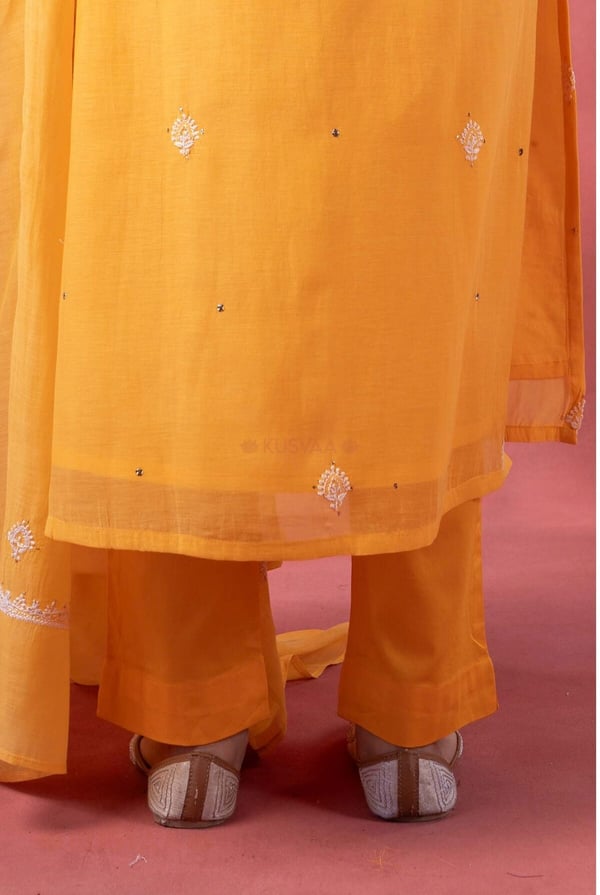
- Sets: pick by the kurta; most pants and palazzos have an elastic or drawstring waist.
- Prefer an easy fit? Size up. Most of our cottons are pre-washed, but a little room is always comfortable in Indian summers.
Still unsure?
Every product page has its own size chart. You can also message us on WhatsApp with your measurements and the style you like — our team will tell you which size to pick — or try it on at a Kusvaa store.


