

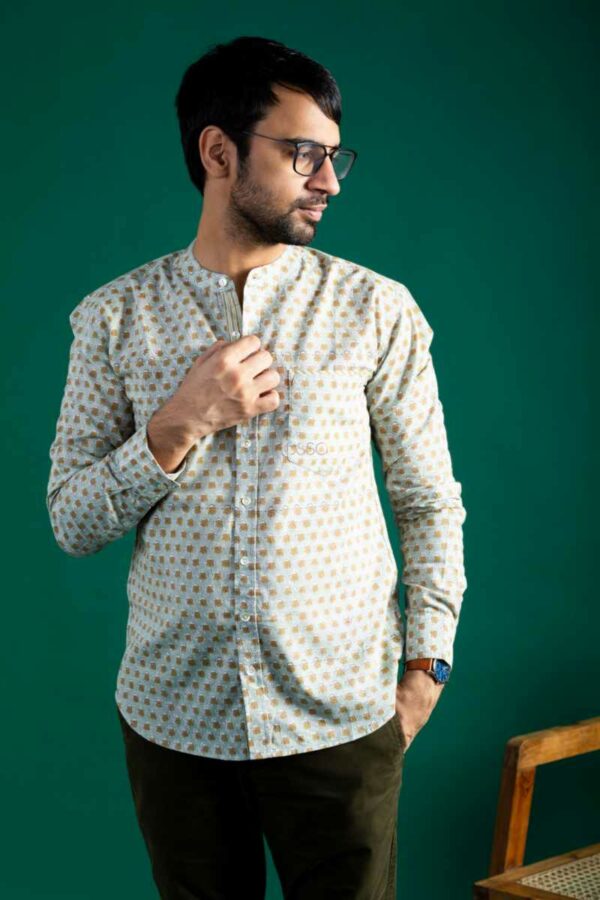


Hand block printing is one of India’s oldest textile crafts. In the villages around Jaipur, families of printers — the Chhipa community — have printed fabric by hand for generations, one carved wooden block at a time.
How it is done
- The blocks: designs are carved by hand into blocks of seasoned wood, often sheesham or teak. A single motif in several colours needs a separate block for each colour — an outline block and filling blocks.
- Preparing the fabric: the cloth is washed to remove starch and, for natural dyes, treated so the colour holds.
- Printing: the printer dips the block into a tray of dye and presses it onto the fabric with a firm strike of the palm, moving along the length, matching each impression to the last by eye.
- Fixing and washing: the printed fabric is dried in the sun, steamed or aged to fix the colour, then washed — traditionally in running water.
Sanganeri
From Sanganer, near Jaipur. Known for delicate floral motifs — small buttis, flowers and vines — usually printed on white or light backgrounds with fine, crisp outlines.
Bagru
From the village of Bagru, about 30 km from Jaipur. Bagru prints are earthier and bolder, with motifs on backgrounds of natural dyes — reds from madder, blacks from iron and jaggery (syahi-begar), and yellows from turmeric and pomegranate.
Dabu
Dabu is mud-resist printing. A paste of clay, lime, gum and wheat chaff is printed onto the fabric with blocks; sawdust is sprinkled on it, and when the cloth is dyed — very often in indigo — the covered parts resist the colour. The paste cracks as it dries, letting a little dye seep in, which creates Dabu’s characteristic fine veins.
How to recognise a real hand block print
- Small shifts or overlaps where one impression meets the next.
- Slight variations in colour depth from one motif to another.
- The print shows through clearly on the reverse of the fabric.
Read how to wash hand block prints, and explore our collections.


