

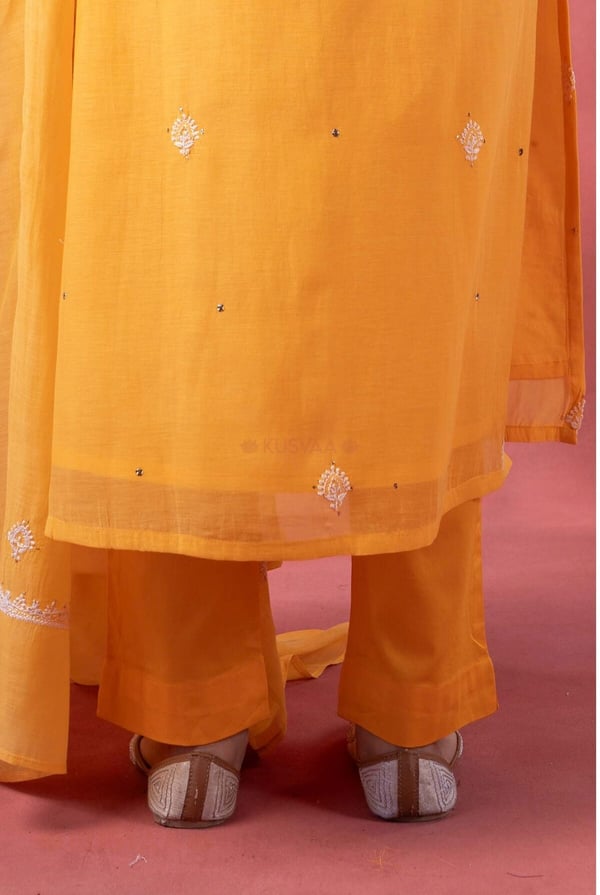

Chikankari is the delicate hand embroidery of Lucknow — traditionally white thread on fine white muslin, so subtle that much of its beauty lies in light and shadow. It flourished under the Mughals and the Nawabs of Awadh, and is still made by thousands of artisans, most of them women, in and around Lucknow.
How it is made
- Cutting and tailoring: the garment is cut first.
- Block printing the design: the pattern is printed onto the fabric with wooden blocks dipped in a washable dye.
- Embroidery: artisans stitch over the printed outlines by hand — a single kurta can take days or weeks.
- Washing and finishing: the piece is washed to remove the printed lines, then starched and pressed.
The stitches
Chikankari uses around thirty stitches. Among the best known:
- Bakhiya: shadow work, stitched on the reverse so the pattern shows through as a soft shadow.
- Phanda and murri: tiny knots that form flower centres and grains.
- Jaali: threads are pulled apart to create a delicate net, without cutting the fabric.
- Tepchi: long running stitches that outline the design.
Recognising hand chikankari
Turn it over: hand embroidery shows small, slightly irregular stitches and knots on the reverse; machine embroidery is perfectly uniform with continuous threads. Hand-done pieces also feel softer and lighter.
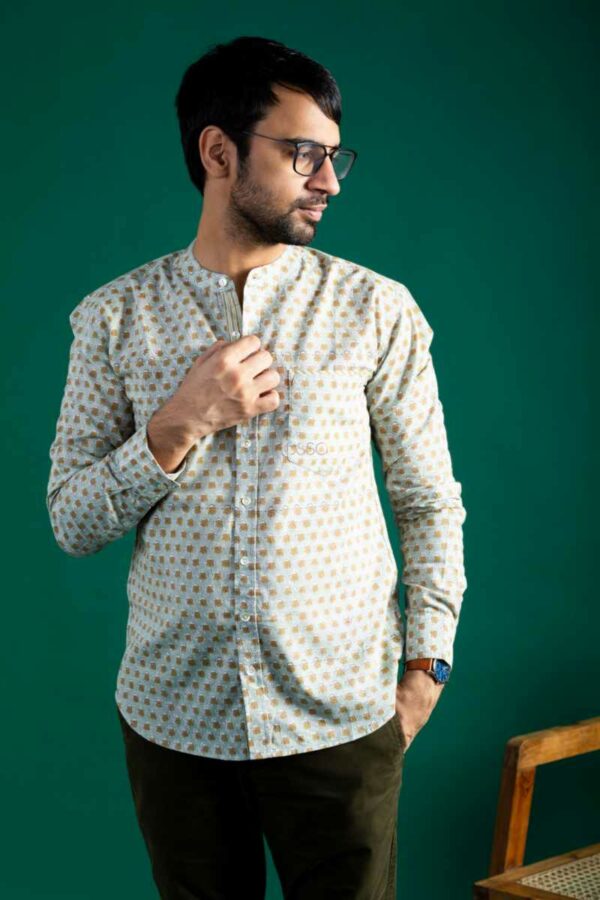
Today chikankari is worked on cotton, mulmul, chanderi and georgette, and in pastel and coloured threads as well as white. Lucknow chikankari received a Geographical Indication (GI) tag in 2008.


